


Flat Rubber Belt
Taizhou Tianou Rubber Co., Ltd. was founded in 2000, located in the eastern side of Tiantai National Scenic Area, has the reputation of "China Belt Industry City". Neighboring Shangshan Expressway, Yongtaiwen Expressway, 104 National Highway, the geographical location is superior, traffic is very convenient.
Why Choose Us?
Quality Products
We have advanced production and testing equipment, and our products meet various standards.
Rich Experience
We have years of industry experience and a team of experienced engineers and technicians to ensure consistent precision and high quality of our products.
Reliable Service
Our team is committed to providing reliable and consistent service, ensuring that you receive high-quality products and customer support from us every time.
Professional Team
The company is in possession of numbers of senior engineers and has abundant technique power, well conditioned equipment and technology comes to perfection.


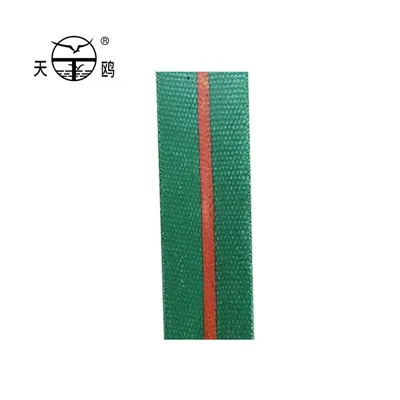


What Is Flat Rubber Belt
Flat rubber belts are power transmission belts that are flat and made of rubber, synthetic composites, or leather. They are used to transfer rotational power in industrial equipment and conveyor systems. Flat belts have a low profile with a positive grip, which makes them suitable for high-speed drive applications.
Flat rubber belt have several advantages compared to other types of power transmission belts such as round belts or V-belts. Some of thes advantages include:
High Speed: Flat rubber belt can operate at higher speeds than other types of belts, making them ideal for applications that require quick and efficient power transmission.
Efficient Power Transmission: Flat rubber belt are designed to transmit power with minimal loss, making them more efficient than other types of belts.
Durability: Flat rubber belt are made from durable materials such as leather, rubber, or synthetic materials, which makes them resistant to wear and tear. They are therefore perfect for usage in challenging industrial settings.
Reduced Noise: Flat rubber belt operate quietly, reducing the level of noise in a manufacturing facility or industrial environment.
Versatile: Flat rubber belt can be used in a variety of applications, from high-speed machinery to conveyors and packaging equipment.
Positive Drive: Flat rubber belt are designed to provide a positive drive, which ensures that the belt does not slip or lose power transmission.


Ease Of Installation: Flat rubber belt are easy to install and maintain, reducing downtime and maintenance costs.
No Stretch: Flat rubber belt are designed to not stretch over time, which reduces the need for frequent tension adjustments.
Clean Operation: Flat rubber belt do not generate debris or oil, making them ideal for use in clean environments.
Cost-effective: Flat rubber belt are generally more cost-effective than other types of belts, making them a cost-effective solution for power transmission needs.
Easy To Customize: Flat rubber belt can be easily customized to meet specific needs and requirements, making them a versatile solution for a wide range of applications.
High Strength: Flat rubber belt are designed to be strong and durable, making them ideal for use in heavy-duty industrial applications.
Flat rubber belt offer a number of advantages over other types of power transmission belts, making them a popular choice for a wide range of applications. Whether one are looking for a solution for high-speed machinery or a cost-effective way to transmit power, flat rubber belt are a reliable and versatile option.
Working Principle of Flat Rubber Belt and Flat Rubber Belt System
Flat rubber belts operate on the friction between the belt and a pulley. For example, when a drive pulley rotates, it creates tension in the flat rubber belt that is transmitted to the driven pulley. The friction between the belt and the pulley provides the force necessary to transfer rotational power.
In a flat rubber belt system, the pulleys must be correctly aligned and the tension properly adjusted to ensure efficient power transmission. The belt must also be lubricated to reduce friction and wear.
The quietest and least vibrational drives are belt drives. The upper portion of the belt, also known as the slack side of the belt, is under tension when the belt is rotating counterclockwise, moving from the driver to the driven pulley or moving forward. This part is always being compressed. The tight side of the belt is the lowest section that is under tension.
The degree of friction between the pulley and the belt determines how much power is transmitted in a belt-drive system. By running the belt at a slower speed, slippage can be removed. To prevent the belt from exiting the pulley, it is crowned, which keeps the belt centered and able to run at faster speeds.
V-belts are used for short distances while flat rubber belt drives are used when there is a greater distance between pulleys or shafts.
The width, thickness, and length of the belt in serves as the specifications for flat rubber belts. While V-belt specifications include length, thickness, angle created by the side surfaces, and width at the higher and lower portions.
Belt ends are fastened with rivets, nuts, bolts, or by lacing or cementing. Ends can also be linked using wires, which is simpler and faster. The surface of a pulley's rim is cambered or slightly rounded, as shown. Crowning or cambering is a process where a flat rubber belt is warped such that it has a bow shape. The camber is the outside edge of a flat rubber belt with the concave middle referred to as the bow.
Belt drives are the quietest and least vibrational drives. The upper portion of the belt, also known as the slack side, is under tension when the belt is rotating counterclockwise, moving from the driver to the driven pulley or moving forward. This part is always being compressed, while the belt's tight side is the lowest section under tension.
The degree of friction between the pulley and the belt determines how much power is transmitted in a belt-drive system. Therefore, slippage can be removed by running the belt at a slower speed. In addition, to prevent the belt from exiting the pulley, it is crowned, which keeps the belt centered and able to run at faster speeds.V-belts are used for short distances, while flat rubber belt drives are used when there is a greater distance between pulleys or shafts.
The belt's width, thickness, and length in serve as the specifications for flat rubber belts. In comparison, the V-belt specifications include length, thickness, angle created by the side surfaces, and width at the higher and lower portions.
Belt ends are fastened with rivets, nuts, bolts, or lacing or cementing. Ends can also be linked using wires, which is simpler and faster. The surface of a pulley's rim is cambered or slightly rounded. Crowning or cambering is a process where a flat rubber belt is warped with a bow shape. The camber is the outside edge of a flat rubber belt with the concave middle referred to as the bow.
Flat rubber belts travel the furthest distance from the pulley axis due to centrifugal force, which is feasible if the belt is in the middle of the pulley. In addition, crowning or cambering minimizes belt slippage when a pulley rotates.
Construction of Flat Rubber Belt
Flat rubber belt are typically made from a combination of rubber and reinforcing fibers. Rubber provides elasticity and resilience for effective power transmission, while the reinforcing fibers provide the strength and stability needed to maintain the belt's shape and prevent stretching.
The rubber used in flat rubber belt can be natural or synthetic. Synthetic rubbers are made from petroleum products and have improved heat, oil, and ozone resistance. Common types of synthetic rubbers are polychloroprene (neoprene), polyisoprene (IR), and styrene-butadiene rubber (SBR).
The reinforcing fibers added to rubber improve flat rubber belt' tensile strength and stability. The most common reinforcing fibers used are polyester, Kevlar, and fiberglass. Polyester fibers are strong, durable, and resistant to elongation, moisture, and chemicals, which makes them a popular choice for flat rubber belt. However, they are more expensive than polyester fibers and have limited resistance to heat. Finally, fiberglass fibers are inexpensive and have resistance to moisture and chemicals. However, they have limited strength compared to polyester and Kevlar fibers.
In addition to rubber and reinforcing fibers, flat rubber belt can contain other materials, such as fillers, antioxidants, and antiozonants, to improve their performance and extend their lifespan. Fillers are added to increase the hardness of the belts, while antioxidants and antiozonants protect the rubber from degradation by heat, ozone, and other environmental factors.
Types of Rubber Belts
Rubber belts are uniform bands made of both natural and synthetic rubber and are widely used in various applications. Rubber Belts are available in various sizes and shapes and used for multitude of purposes. These belts include a wide range of rubber belts. Rubber belts can be classified as :
● Anti-static belts: They contain no static prone materials like carbon.
● Anti-vibration belts: They minimize vibrations in conveyor systems and the vibrations slowly abrade and stretch belts.
● Armored belts: They have crosswise insertions in the cover, made of materials like steel. This is to decrease tearing by sharp conveyed objects.
● Cable belts: They are reinforced with cables.
● Endless round belts: They are single piece belts. They are designed to stretch and do not require belt tension.
● Fin belts: They have fin-like structures which are protruded from the belts themselves. They are useful in applications such as catching containers and moving them into boxes.
● Multi-speed belts: They are used in variable speed applications such as automobiles and snowmobiles.
● Twisted belts: They are used to replace endless round belts that are damaged or destroyed.
● V-belts: They have a v-shaped profile having different variations of the v-belt.
These rubber belts have high strength, good flexibility and elasticity. These are used in factories, mines, docks, metallurgical industries, airports, irrigation equipment, power transmission equipment, wood cutting and in various other applications for industry and agriculture.
Types of Flat Belts
There are several types of flat belts, including:
Rubber Belts
Rubber flat belts were originally introduced as a replacement for leather belts but were replaced by V-belts due to mistracking and problems with high tension. However, recent technological developments in the manufacturing of flat belts have made them more practical and cost-effective. In addition, they have high elasticity and offer excellent grip, making them suitable for high-speed and heavy-duty applications.
The rise in the use of flat belts is due to their excellent efficiency and low bending loss from their thin cross-section and low creep. Additionally, flat belts have less wear than V-belts and come in widths to fit any application.
Timing Belts
Timing belts have rubber teeth on their inner side to provide a positive grip for precision timing and power transmission. They are used to maintain timing between components of mechanical systems and are essential for machine performance.
The materials used to manufacture timing belts include natural rubber and synthetic rubbers such as neoprene, polyurethane, and saturated nitrile. The rubber material is reinforced with cords to reduce the tendency of rubber to stretch and deform.
Unlike other flat belts, timing belts have teeth used to grip the pulleys of machines. The teeth have a trapezoidal or curvilinear shape to fit into the pulleys to which they are attached.
V-Belts
V-belts have a trapezoidal cross-sectional shape and are used to transmit power from driving components. Their design aims to avoid slippage and improve gripping, making them more dependable and efficient. In addition, the V-shape increases contact between the belt and pulleys it drives, making V-belts suitable for high-torque applications.
All V-belts are made of rubber with reinforcing cords to enhance their strength. In addition, to give V-belts increased durability and toughness, they are covered with a protective fabric or wrapped in rubber.
Poly-V Belts
Flat poly V-belts have multiple V-shaped ribs on their inner surface that mesh with pulley grooves to increase grip and reduce slippage. The ribs of a poly V-belt run along the full length of the belt longitudinally to make contact with the grooves of a pulley. As a result, the tension of a poly flat V-belt is evenly distributed over the width of the pulley.
The multiple ribs of poly V-belts reduce the thickness of the belt to give the belt greater flexibility and the ability to be wound tightly.
Wedgelock Belts
Wedgelock belts are a subset of V-belts with steeply angled walls to increase their load-bearing wedging capabilities. They have the typical trapezoidal shape with variations in their dimensions to meet their wedging capacity.
The design of wedgelock belts helps prevent slippage and improves power transmission efficiency. They are commonly used in heavy-duty applications, such as industrial machinery and power transmissions, and are made of various forms of rubber.
Fabric Ply Belts
Made with multiple layers of fabric material and designed for applications requiring heavy-duty strength and durability. The fabric layers are typically reinforced with synthetic materials such as polyester or nylon to increase resistance to stretching and wear.
Fabric Cord Belts
Similar to fabric ply belts, but made with a single layer of fabric material that is reinforced with cords. The cords provide additional strength and stability to the belt, making them ideal for applications requiring high-tension loads.
Synthetic Flat Belts
Made with synthetic materials such as polyurethane or silicone, synthetic flat belts are known for their durability, flexibility, and resistance to wear and abrasion. Synthetic flat belts are used in a variety of industrial applications, including packaging, food processing, and power transmission.
In general, the choice between fabric ply, fabric cord, and synthetic flat belts will depend on the specific application requirements and operating conditions, such as load capacity, temperature, and exposure to chemicals.
Raw Edge Belts
Raw edge belts are designed to provide maximum grip and prevent slippage, making them ideal for high-torque applications. They are typically made from a combination of synthetic rubber and reinforcing fibers and are available in a range of sizes and strengths.
Flat Wrapped Belts
Flat wrapped belts are similar to raw edge belts, but feature a wrapped construction that helps to provide additional stability and strength. This type of belt is often used in high-stress applications, such as power transmissions and industrial machinery.
Leather Belts
Leather belts were introduced during the first industrial revolution and were used through the end of the 19th and into the 20th century. They were replaced by flat rubber belts but are still used for some applications today and are available in one, two, or three ply. Leather belts have a smooth surface and are flexible, which makes them ideal for small diameter pulleys.
The process of making flat rubber belt begins with selecting the type of rubber and reinforcing materials that will be mixed, molded, cured, cut, and joined. flat rubber belt are made from natural rubber or synthetic rubbers with additives, such as cords, fabric coverings, and other features. The result of the process is a durable and reliable flat belt.
The selected materials for a flat belt are blended, heated, and placed in a mold under pressure to cure the rubber. Molds for manufacturing flat rubber belts are made of hardened steel and other forms of metal, with steel being the most common.
The key to manufacturing rubber flat rubber belt is vulcanization, which changes the properties of rubber to increase its strength, elasticity, and durability. There are several forms of vulcanization, with all types using sulfur as an activation agent. The vulcanization process cross-links the rubber molecules to give a flat belt its tensile strength and resistance to stretching.
Once the rubber has cured, the mold is opened, and the cured belt is removed. It is then cut to the desired lengths and has its ends joined to form a continuous loop, a process that is completed using heat and pressure.
In addition to the basic process for making flat rubber belt, manufacturers may add additional features to improve belts' performance and longevity, such as coating the surface of the belt to increase its resistance to heat, oil, and abrasion. In addition, notches may be added to increase a belt's grip and prevent slippage.

Flat rubber belt, also known as flat belt drive systems, are commonly used in industrial and mechanical settings to transmit power from one pulley to another. They are typically made from flexible and durable rubber or synthetic rubber and have a flat, smooth surface.
Power transmission by a flat belt can take many forms and are part of two pulley drives, including a drive pulley, a driven pulley, and a flat belt. A major feature of flat rubber belt is their ability to be customized to fit any application. For example, they can be designed with tracking sleeves or can have the coefficient friction adjusted to prevent slippage.
Conveyors
Flat rubber belt are often used in conveyor systems to transport materials such as boxes, packages, and raw materials from one location to another.
Printing Presses
Flat rubber belt are used in printing presses to transfer power from the motor to the printing cylinders.
Machine Tools
In machine tools such as lathes, flat rubber belt are used to transfer power from the motor to the cutting tools.
flat rubber belt can be used in power transmission systems to transfer power from a motor to a machine, such as an agricultural pump or a generator.
Textile Machinery
Flat rubber belt are used in textile machinery to transfer power to spindles, needles, and other components. Textile industry flat rubber belt are used for a variety of applications within the textile industry, including power transmission, material handling, and process control. They are commonly used for driving and conveying equipment, such as spinning and weaving machines, calenders, and finishing machines.
In the textile industry, flat rubber belt are often preferred over round belts because they offer a larger surface area for carrying the load and they can be made in different widths and thicknesses to match specific requirements.
The key factors to consider when selecting flat rubber belt for the textile industry include the load to be transferred, the speed of the belt, the center-to-center distance between the pulleys, and the operating environment (temperature, exposure to chemicals, etc.). It is important to select a belt that is suitable for the specific conditions of the application to ensure optimal performance and long service life.
Some popular types of flat rubber belt used in the textile industry include leather belts, synthetic belts, and rubber belts. It is important to choose a belt material that is durable, flexible, and resistant to the specific conditions of the application.
Calculations to Determine the Correct Flat Rubber Belt
Belt Length: Belt length is the measure of the distance between the two pulleys and the distance around the circumference of the pulley. It is calculated using the following formula: Belt Length = 2π x Pulley Radius + 2 x Arc Length.
Operating Tension: The belt's width has to handle the load and provide sufficient grip on the pulley. The operating tension is the amount of tension needed to transmit the load and is used to determine belt width.
Center-to-Center Distance: The center-to-center distance is the distance between the centers of the pulleys and is part of the calculation of the belt length.
Pulley Diameter: The belt needs to fit the diameter of the pulley and its grooves properly. The diameter affects the belt length as specified by the manufacturer.
Load to be Transferred: The load to be transferred is used to determine the operating tension and the appropriate belt width.
Belt Speed: The speed at which the belt runs affects the operating tension and is typically specified by the manufacturer.

Considerations When Using a Flat Rubber Belt
Maintenance: Maintenance requirements refer to the cost of repairs or replacements.
Noise Level: The noise level generated by a flat rubber belt and its pulley system.
Belt Material: Selecting the right material for the job necessitates examining the environment, including temperature, humidity, and chemical exposure.
Compatibility: The belt and pulley materials should be compatible to avoid slippage and failure.
Cost: Cost is an aspect of every industrial purchase. When examining flat rubber belts, the initial cost may be high due to the type of material. However, if the selected materials are long-lasting, the cost can be amortized over the belt's lifespan (up to several years) before replacement. The cost of the replacement belt is another factor.
Belt Materials
The material used for the belt must be strong enough, flexible, and durable and have a high coefficient of friction and withstand high tension.
Belts used for power transmission consist of any one of the following material as listed below.
Balata
The balata belts are manufactured by using balata, which is obtained from the tree.
Fabric
The fabric belts are made from canvas or cotton impregnated with rubber and are suitable for warm climates.
Canvas
If the belt is made up of cotton, they are called as canvas belts. Canvas belts are cheaper, resistant to moisture, and can operate at high speeds.
These belts can be produced with a suitable width, thickness, and length, and these can be used in warm climates.
Rubber
The rubber belts cannot be used in the presence of oils and greases, and they cannot tolerate high temperature. In rubber belts, the fabric is used to manufacture them, and then they are coated with rubber materials.
Leather
Usually, the common material used for the belt is leather, because they can tolerate medium temperature and are less costly.
But leather belts are not suitable for high-temperature applications because the shape and size of the belt may change due to high temperature.
But the leather belts have a high coefficient of friction and high power transmitting capacity.
The belt ends may be joined by riveting, lacing or cementing method.
During the joining of belt ends, the two ends of the belt are first lapped and riveted with suitable rivets or the belt ends are butted, and the lace is threaded.
However, due to improved methods available, the leather and balata belts are produced by cementing method. This will give the highest strength to the belt joint.
Flat Rubber Belt Selection
Power Transmission Requirements
Flat rubber belts can transfer power in a wide range of applications. We need accurate data with the appropriate safety factor to determine the type of belt that is best suited for the application.
Shaft Separation
Every flat rubber belt has an optimal distance at which it performs best. A small distance between the shafts would suggest the use of jockey pulley drive while long distances would permit an open flat rubber belt for cost savings.
Service Environment
Service environment factors such as oil, moisture, high temperatures, dust, snow etc. Can affect many parameters such as belt wear, belt life, material, function and slip. The selection of flat rubber belt must focus on the service environment that the belt must endure for a satisfactory wear life.
Space Constraints
Limited available space can direct us towards more compact assemblies. Compact setups with hex belts or compound drives can significantly reduce the amount of space a flat rubber belt requires.
Type Of Driven Load
The loads driven by belts can be jerky, shock-prone or reversible. The selection process must opt for belts and pulleys that can manage such loads to ensure compatibility.
Speed Ratio
Most flat rubber belts have speed ratio greater than one which means that the driven pulley is larger than the driving pulley. In order to achieve this speed ratio, the designers can either increase the size of the driven pulley or reduce the size of the driving pulley.
But there are certain limitations in both. Increasing the size of the driven pulley drives up the costs and space requirements. Decreasing the size of the driving pulley can only be done to a certain extent as the belt must be capable of bending and wrapping around the driving pulley. Small pulleys increase the elongation of the belt's outer fibres, exacerbating belt wear and life expectancy.
To add to this, both pulleys cannot be too small as that would result in a high belt velocity which is detrimental to belt life as well.
Our Certificate


FAQ
Q: What is the difference between flat belt and open belt?
Q: What is the shape of a flat belt?
Q: What are the 4 flat belt classifications?
Q: What are the three types of conveyor belts?
Q: What materials are used for flat belts?
Q: How to make rubber conveyor belt?
Q: Where are flat belts used?
Q: How tight should a flat belt be?
Q: What type of rubber belt is used in conveyor belts?
Q: How do flat belts stay on pulleys?
Q: What is flat belt pulley?
Q: What are rubber belts used for?
Q: Why are flat belts still used?
Q: What is the crown on a flat belt pulley?
Q: What is the difference between a flat belt pulley and a V belt pulley?
Q: What is conveyor belt rubber made of?
Q: How does a flat belt pulley work?
Q: What material is a flat pulley belt?
Q: How do I keep my flat belt from slipping?
Q: Why are flat belt pulleys crowned?